
Introduction
Applying for a federal job takes time. Applicants need to update their resumes, verify employment details, upload supporting documents, and answer eligibility questions. After submitting the application, they receive a confirmation and wait for the next update.
But the hiring agency’s work is only getting started.
The application moves through assessments, hiring decisions, subject matter expert reviews, and HR screening. People who need information to do their jobs are involved at each stage, but they may not be able to access all of an applicant’s details.
Protecting applicant data is important throughout this process. Agencies must ensure that personal information is handled securely, shared only with authorized individuals, and properly accounted for at every stage of hiring.
One Application, Multiple Points of Responsibility
Applicant information can be difficult to manage when documents are downloaded, emailed between reviewers, or maintained in separate spreadsheets. Each additional copy makes it harder to know who has access, where the information is stored, and whether the review process has been properly documented.
Understanding Federal Applicant Data Security Requirements
Federal agencies handle a considerable amount of personal information during recruitment. Protecting that information involves several laws, security frameworks, and privacy requirements.
The 1974 Privacy Act
The Privacy Act creates guidelines for federal agency systems of records that hold personal data. Agencies must be aware of the types of application data they gather, how they might use or disclose it, and which privacy notices and safeguards are applicable.
FISMA, or the Federal Information Security Modernization Act
FISMA requires federal agencies to use established security procedures, evaluations, and continuous oversight to address information security threats. This implies that security for hiring systems must be considered at every stage of the system’s operation, not just during initial implementation.
NIST SP 800-53
Program for Federal Risk and Authorization Management (FedRAMP)
A uniform method for evaluating and approving cloud services utilized by federal agencies is offered by FedRAMP. When assessing a service, agencies might consider the security assessment evidence it offers for cloud-based hiring platforms that fall within its purview. Every agency must nonetheless take into account its own authority and operating demands.
These frameworks address different aspects of information security, but they share a common objective: ensuring that applicant data remains protected throughout its lifecycle.
Where Applicant Information Becomes Vulnerable
A data security problem doesn’t always begin with a cyberattack. Sometimes, it starts with an ordinary task, such as sharing a resume with a reviewer or leaving an old account active.
Here are five common areas that need attention.
- Access beyond what is required
Unrelated personal information may not be necessary for a reviewer evaluating a candidate’s technical abilities. When permissions are too broad, sensitive information can become visible to people who don’t need it for their work. - Documents shared outside the hiring system
Emailing resumes or keeping separate copies for review panels can make applicant information harder to track. Agencies need to know where these documents are stored, who can access them, and how they are protected. - Inadequate account security
Compromised passwords, inactive accounts, and excessive user privileges can put applicant information at risk. Strong authentication and regular account reviews help reduce these vulnerabilities. - Insufficient user activity records
Investigating an issue becomes difficult if an organization is unable to determine who accessed an application, entered an evaluation score, or made a change. Accurate audit logs help establish what happened and support accountability. - Uncertain retention procedures
Applicant records may need to be retained after a vacancy closes. Keeping them longer than required can increase exposure, while deleting them too early may conflict with records-management requirements.
The majority of these risks can occur during standard hiring procedures. It is as crucial as the technology used to hold the data are clear procedures, appropriate access controls, and constant supervision.
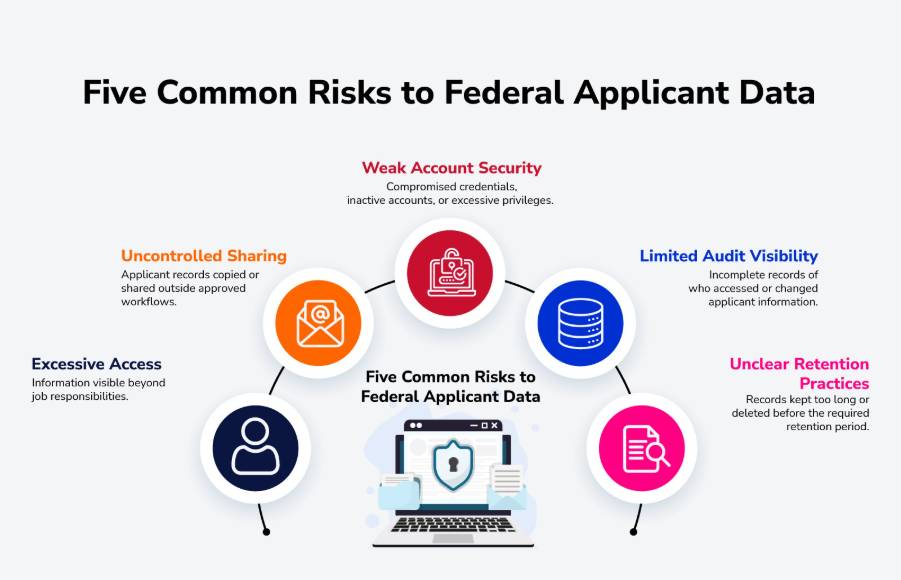
Five Common Risks to Federal Applicant Data
- Excessive Access
Information visible beyond job responsibilities. - Uncontrolled Sharing
Applicant records copied or shared outside approved workflows. - Weak Account Security
Compromised credentials, inactive accounts, or excessive privileges. - Limited Audit Visibility
Incomplete records of who accessed or changed applicant information. - Unclear Retention Practices
Records kept too long or deleted before the required retention period.
Building Security into Every Stage of Hiring
Agencies need to protect applicant information without making everyday hiring tasks unnecessarily difficult. The following practices help support both goals.
Permit Access in accordance with Individual Responsibilities
Not all hiring parties require the same information.
While a subject matter expert might want assessment materials, an HR specialist might require access to application records. Hiring managers need information relevant to their decisions. Permissions should be defined as responsibilities change, and role-based access helps organizations in establishing these boundaries.
Safeguard Data While It Is Being Stored and Transferred
Encryption helps protect applicant information while it is stored and transferred between systems.
Agencies should also review how records are exported, transferred, or shared with connected services. Information must be protected outside of the primary hiring platform as well.
Keep Accurate Activity Records
Audit logs help agencies track relevant activities within a hiring system.
For example, an agency may need to confirm who accessed an applicant’s record, when an assessment score was entered, or whether a review was completed. These logs are most useful when they are protected, retained appropriately, and reviewed whenever necessary.
Establish Routine Authentication and Monitoring
Strong authentication and regular account reviews help prevent unauthorized access.
Agencies should promptly deactivate accounts that are no longer needed. They should also monitor for suspicious activity, vulnerabilities, and configuration changes. These checks must continue throughout the system’s lifecycle.
Maintain Applicant Records After the Selection Process
Applicant information remains sensitive even after a hiring decision has been made.
Agencies must follow applicable retention schedules, restrict access to records that need to be kept, and dispose of information when authorized.
The goal is to retain records for the required period, protect them while they are stored, and dispose of them appropriately when the time comes.
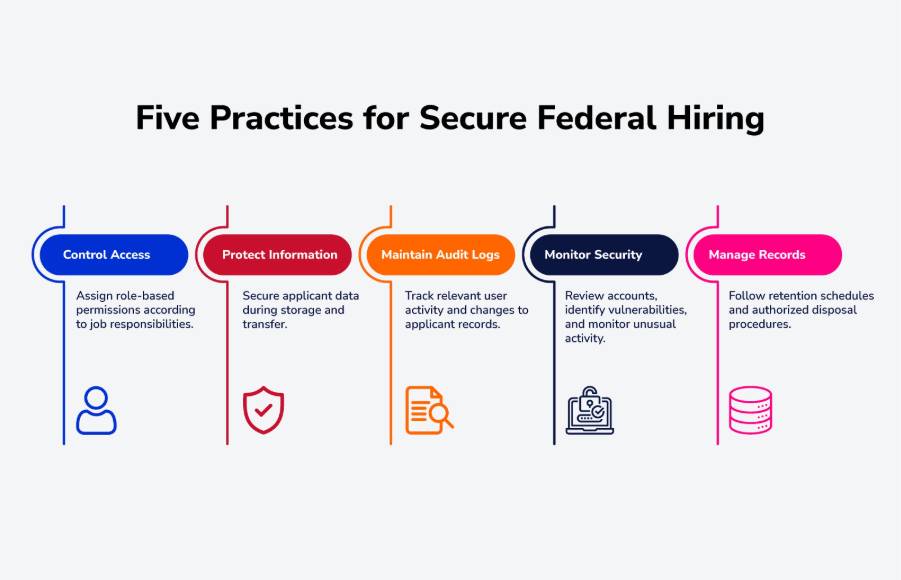
Five Practices for Secure Federal Hiring
- Control Access
Assign role-based permissions according to job responsibilities. - Protect Information
Secure applicant data during storage and transfer. - Maintain Audit Logs
Track relevant user activity and changes to applicant records. - Monitor Security
Review accounts, identify vulnerabilities, and monitor unusual activity. - Manage Records
Follow retention schedules and authorized disposal procedures.
Secure Hiring Can Also Make the Process Easier
When applicant records, assessments, and reviewer feedback are managed through controlled workflows, HR teams spend less time tracking documents and checking different versions of the same information.
They can also see which reviews are completed, who submitted an evaluation, and what information is available for the next hiring decision.
Although this doesn’t eliminate every security risk, it helps agencies manage applicant information more consistently and makes the hiring process easier to oversee.
How ApplyGov Supports Secure Federal Hiring
Apply Government Solutions (ApplyGov) develops technology to support federal hiring teams. Its FedHire talent acquisition system supports different stages of recruitment, including vacancy announcements, application tracking, assessments, collaboration, and selection.
FedHire Hiring Management helps agencies manage hiring activities, track applications, communicate with applicants, and maintain records of user activity.
FedHire Hiring Assessments supports integrated assessments, with results returned to applicant records for authorized screening and review.
FedHire Collaborate provides a centralized environment where subject matter expert panels can review applicant materials, record ratings, and document evaluations. This reduces the need to exchange feedback through separate emails and spreadsheets.
Security is also an important consideration for the platform. ApplyGov states that FedHire has maintained a FedRAMP agency authorization at the Moderate level, originally under the Monster Government Solutions name. Agencies evaluating the platform should review the available security documentation to determine how it meets their operational and authorization requirements.
By bringing hiring activities and review records into connected workflows, FedHire can help agencies manage applicant information with consistency and oversight.
Protecting Applicant Data Throughout the Hiring Process
Submitting an application is only the beginning of an agency’s responsibility for protecting a candidate’s information.
Applicant records must be appropriately protected from the initial eligibility review to the employment decision. This includes limiting access, protecting data transfers, keeping accurate audit records, and adhering to retention regulations.
As federal hiring systems evolve, agencies need processes that allow hiring teams to work efficiently without exposing sensitive information.
Applicants share their employment history, qualifications, and other personal details with the expectation that the information will be handled responsibly. Protecting it throughout the hiring process is essential to maintaining their trust002E